
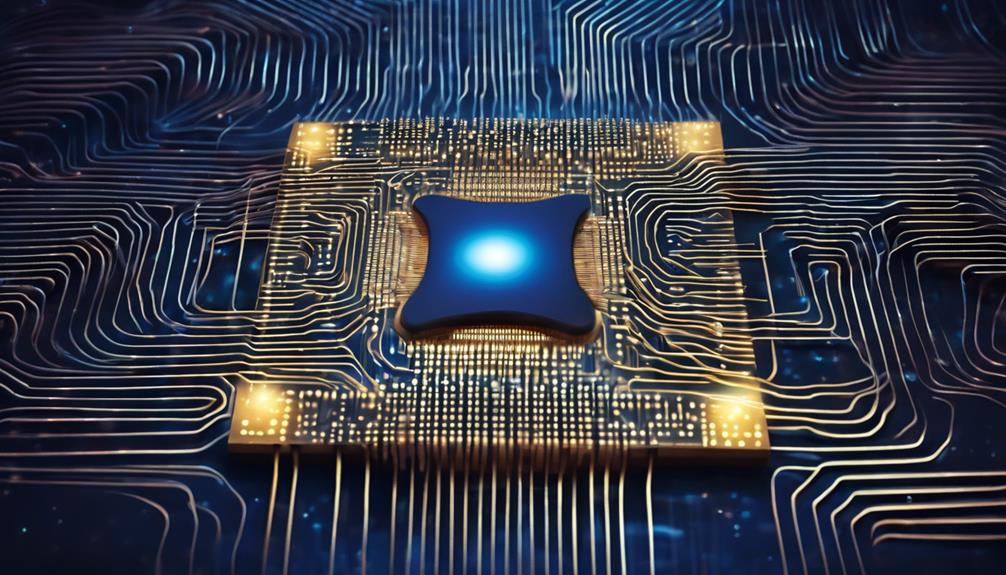
Photonic computing is harnessing the speed of light to process data at unprecedented speeds, outpacing traditional electron-based computing. Photons transmit data at 186,000 miles per second, far surpassing electrons' 1-10 miles per second pace. This enables faster, farther, and more reliable data transmission. Photonic chips integrate optical components, facilitating seamless processing, and consume less power. With the rise of optical interconnects and advances in algorithm optimization, photonic computing drives breakthroughs in data compression, complex problem-solving, and various fields like medicine and finance. As the boundaries of data processing continue to blur, the full potential of photonic computing remains to be uncovered.
How Photons Outperform Electrons
In computing, photons outperform electrons in speed, transmitting data at rates of up to 186,000 miles per second, compared to electrons' sluggish pace of 1-10 miles per second. This drastic difference in speed has significant implications for the future of computing. Photons, being massless particles, can travel at the speed of light, making them ideal for high-speed data transmission. In contrast, electrons, being charged particles, are much heavier and slower.
The impact of this speed difference is monumental. Data highways, once congested by slow-moving electrons, can now be upgraded to accommodate the blistering pace of photons. This means that data can be transmitted faster, farther, and more reliably than ever before. The implications for high-performance computing are enormous, enabling applications that were previously unimaginable.
The Rise of Optical Interconnects
Optical interconnects are rapidly emerging as the preferred solution for high-speed data transmission within computing systems. As data rates continue to skyrocket, traditional copper interconnects are struggling to keep up. With their limited bandwidth and high power consumption, they're becoming a major bottleneck in high-performance computing. Optical interconnects, on the other hand, offer a scalable and energy-efficient solution, enabling data transfer rates of up to 100 Gbps and beyond.
The integration of silicon photonics with CMOS technology has been a game-changer, enabling the mass production of optical interconnects. This silicon integration has led to a significant reduction in cost and size, making optical interconnects a viable option for a wide range of applications. Additionally, the development of high-speed networking protocols has further accelerated the adoption of optical interconnects, enabling seamless communication between devices and systems.
As the demand for high-speed data transmission continues to grow, optical interconnects are poised to play an increasingly important role. With their ability to support high-bandwidth, low-latency data transfer, they're set to revolutionize the way we design and build computing systems. Whether it's in data centers, high-performance computing, or artificial intelligence applications, optical interconnects are the key to tapping into the full potential of photonic computing.
Quantum Leaps in Data Processing
Silicon photonics' ability to process vast amounts of data at unprecedented speeds has sparked a quantum leap in data processing, enabling the development of novel computing architectures that can tackle complex problems in fields like artificial intelligence and machine learning. This exponential increase in processing power has paved the way for breakthroughs in data compression, allowing for the efficient handling of massive datasets.
Algorithm optimization has also seen significant advancements, as photonic computing enables the parallel processing of complex algorithms at unprecedented speeds. This has far-reaching implications for fields like cryptography, genomics, and climate modeling, where complex calculations can be performed in a fraction of the time previously required.
The implications of this quantum leap in data processing are profound, enabling researchers to address previously intractable problems with ease. With the ability to process vast amounts of data in real-time, scientists can now uncover insights that were previously concealed, driving innovation and discovery in fields like medicine, finance, and astronomy. Additionally, as quantum computing and technology advancements continue to evolve, they will facilitate more accurate simulations and models, leading to breakthroughs that were once thought impossible. This transformative power not only enhances research capabilities but also accelerates the pace at which new discoveries can be made. Ultimately, the integration of these advanced technologies holds the potential to revolutionize our understanding of complex systems and phenomena across multiple disciplines.
As photonic computing continues to advance, we can expect to see even more remarkable breakthroughs in data processing, enabling humanity to address the most complex challenges of our time. With its unparalleled processing power, photonic computing is poised to revolutionize the way we approach complex problem-solving, revealing new possibilities for human progress.
Breaking Barriers With Photonic Chips
By integrating photonic components onto a single chip, researchers have successfully broken down the barriers between electronic and photonic systems, enabling seamless data transfer and processing at unprecedented scales. This breakthrough has opened up new avenues for high-speed data processing, paving the way for faster and more efficient computing.
The key to this achievement lies in the successful integration of photonic components onto a silicon chip, leveraging the strengths of both electronic and photonic systems. This integration enables the creation of hybrid photonic-electronic chips, capable of processing vast amounts of data at incredible speeds.
Some of the key benefits of this technology include:
- Scalability: Photonic chips can be manufactured using traditional wafer manufacturing processes, making them scalable and cost-effective.
- Speed: Photonic chips can process data at speeds of up to 100 Gbps, making them ideal for high-speed applications.
- Power efficiency: Photonic chips consume considerably less power than traditional electronic chips, making them ideal for energy-conscious applications.
Unleashing the Power of Light
As researchers continue to push the boundaries of photonic computing, they're now harnessing the power of light to address complex computational tasks, tapping into the potential of unprecedented processing capabilities. This represents a significant leap forward in the field, as light-based computing offers exponentially faster data transfer rates and lower energy consumption compared to traditional electronic computing.
| Light Propagation | Optical Revolutions |
|---|---|
| Faster Data Transfer | 10x increased processing power |
| Low Energy Consumption | Reduced heat generation |
| Scalability | Increased computing density |
The power of light is being utilized to drive Optical Revolutions in computing. By harnessing the speed and efficiency of light propagation, researchers are creating photonic chips that can process vast amounts of data at unprecedented speeds. This breakthrough has far-reaching implications for fields such as artificial intelligence, data analytics, and cybersecurity.
As the power of light continues to be harnessed, the possibilities for photonic computing seem endless. With the ability to process vast amounts of data in real-time, the potential applications are vast and varied. From accelerating medical research to enhancing national security, the impact of photonic computing will be felt across industries and disciplines.
Frequently Asked Questions
Can Photonic Computing Be Used for Everyday Consumer Devices?
She wonders if photonic computing can be used for everyday consumer devices. The answer lies in its potential to revolutionize user experience. With photonic computing, devices can process data faster and more efficiently, providing a seamless user experience. Additionally, photonic computing's power efficiency is unparalleled, making it an attractive option for consumer devices. It's likely that photonic computing will soon become a staple in everyday consumer devices, empowering users with lightning-fast performance and extended battery life.
Are Photonic Chips More Expensive to Manufacture Than Traditional Chips?
Like a master craftsman polishing a precious gem, manufacturers face a challenging task when producing photonic chips. The cost analysis reveals a sobering truth: photonic chips are indeed more expensive to manufacture than their traditional counterparts. The culprit lies in the intricate manufacturing challenges, such as precision-crafting microscopic components and integrating light signals. As a result, the cost of production skyrockets, making photonic chips a luxury few can afford.
How Does Photonic Computing Reduce Heat Generation in Devices?
She explains that photonic computing reduces heat generation in devices by leveraging light-based data transmission, which greatly decreases energy consumption. This, in turn, minimizes thermal management issues, allowing for more energy-efficient systems. By harnessing photons instead of electrons, photonic chips dissipate less heat, resulting in cooler, faster, and more reliable performance. This technology breakthrough enables the development of powerful, eco-friendly devices that don't sacrifice speed for energy efficiency.
Can Photonic Computing Be Used for Artificial Intelligence Applications?
Silky streams of data swirl, seeking sophisticated solutions. Can photonic computing be harnessed for artificial intelligence applications? Absolutely, it can! By leveraging photonic chips, neural networks can be enhanced, enabling faster intelligent systems. Cognitive architectures can be revolutionized, and deep learning can reach unprecedented speeds. With photonic computing, AI pioneers can access unprecedented power, driving innovation and shaping the future of intelligent systems.
Are Photonic Computers More Prone to Data Breaches or Cyber Attacks?
She explores the vulnerability of photonic computers to data breaches and cyber attacks. According to experts, these systems are not inherently more prone to attacks. In fact, photonic computers can leverage secure networks and quantum encryption to enhance data protection. This fusion of technologies can create an ultra-secure environment, safeguarding sensitive information from potential threats. As a result, photonic computers can provide a robust defense against cyber attacks, ensuring the integrity of sensitive data.