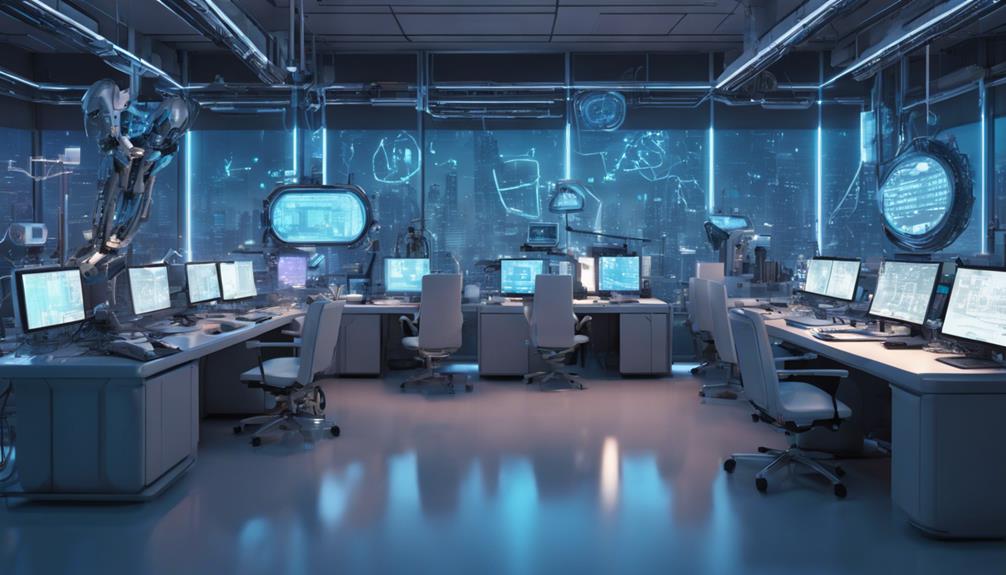

New technologies are revolutionizing space exploration, making it more accessible, efficient, and affordable. Reusable rockets, like those developed by SpaceX, are drastically reducing costs and environmental impact. Artificial intelligence is minimizing human error, optimizing spacecraft operations, and enabling autonomous decision-making. Quantum computing is streamlining mission planning, resource allocation, and fuel efficiency. Commercial space stations are opening up new opportunities for space tourism, research, and manufacturing. Advanced life support systems and in-orbit assembly are enabling longer, more complex missions. As these innovations continue to propel space exploration forward, humanity's presence in space is poised to expand in unprecedented ways.
Reusable Rockets Take Center Stage
As private companies like SpaceX and Blue Origin pioneer the development of reusable rockets, how will this paradigm shift transform the economics and logistics of space travel? The answer lies in the significant cost savings and increased efficiency that reusable rockets offer. With the ability to refurbish and relaunch rockets, companies can drastically reduce the costs associated with building and launching new rockets from scratch. This reduction in costs is largely due to the decreased need for raw materials and manufacturing processes.
Rocket refurbishment has become an essential aspect of reusable rocket technology. By refurbishing and reusing rockets, companies can minimize waste and reduce the environmental impact of space travel. Additionally, refurbishment allows for the efficient allocation of resources, enabling companies to redirect funds towards research and development.
Another significant advantage of reusable rockets is the improvement in fuel efficiency. With the ability to precisely control the rocket's descent and landing, companies can optimize fuel consumption, reducing waste and increasing the overall efficiency of the rocket. This increased fuel efficiency directly translates to cost savings, making space travel more accessible and affordable. As the space industry continues to evolve, the development of reusable rockets is poised to revolutionize the economics and logistics of space travel, paving the way for a new era of space exploration.
Artificial Intelligence in Space
Over 90% of spacecraft malfunctions are attributed to human error, and artificial intelligence is poised to revolutionize space exploration by mitigating this risk. By leveraging AI, space agencies and private companies can greatly reduce the likelihood of human-induced errors, ensuring that space missions are safer and more efficient.
AI is particularly valuable in space exploration due to its ability to process vast amounts of data quickly and accurately. This enables spacecraft to make autonomous decisions in real-time, without human intervention. For instance, AI-powered systems can analyze sensor data to detect potential issues before they become critical, allowing for prompt corrective action. Additionally, AI can optimize spacecraft operations, such as navigation and communication, to maximize efficiency and reduce fuel consumption.
However, as AI assumes a more prominent role in space exploration, AI Ethics become an important concern. It is essential to establish clear guidelines and regulations governing the development and deployment of AI in space. This includes ensuring that AI systems are designed with safety and transparency in mind, and that they align with human values and principles.
As AI continues to advance, Space Autonomy will become an increasingly important aspect of space exploration. AI-powered spacecraft will be capable of operating independently, making decisions and adapting to new situations without human oversight. This breakthrough will open up new possibilities for deep space exploration, enabling humanity to venture further into the cosmos than ever before.
Quantum Computing for Space Exploration
As space exploration continues to push the boundaries of what's possible, quantum computing is poised to play a pivotal role in optimizing space mission planning. By harnessing the power of quantum processing, scientists can crunch complex data sets at unprecedented speeds, shaving precious time off mission planning and execution. This means that quantum computing can help space agencies make the most of their resources, getting them to their destinations faster and more efficiently.
Optimizing Space Mission Planning
What role can quantum computing play in revolutionizing space mission planning by optimizing complex trajectories and resource allocation? The answer lies in its ability to process vast amounts of data exponentially faster than classical computers. By harnessing the power of quantum computing, space agencies can optimize mission phasing, ensuring that multiple spacecraft and payloads are deployed at the most opportune times to maximize scientific returns. This means that resources can be allocated more efficiently, reducing costs and minimizing waste. Quantum computers can also analyze complex trajectory data to identify the most fuel-efficient routes, reducing travel times and increasing the overall success of space missions. Additionally, quantum computing can facilitate real-time resource allocation, allowing mission controllers to respond quickly to changing circumstances and make data-driven decisions. By integrating quantum computing into space mission planning, space agencies can access new levels of efficiency, precision, and innovation, paving the way for a new era of space exploration.
Faster-than-Light Data Processing
Quantum computing's ability to process vast amounts of data exponentially faster than classical computers is revolutionizing space exploration, and its impact on data processing is particularly noteworthy. This technology is poised to transform the space industry by enabling faster-than-light data processing, an essential component of deep space missions. By leveraging quantum computing's power, space agencies can analyze massive datasets in real-time, facilitating more accurate predictions and informed decision-making. Neural networks, a key application of quantum computing, will enable spacecraft to learn from experience, adapting to unforeseen circumstances and optimizing their performance. Cosmic computing, a new frontier, will allow for the simulation of complex astrophysical phenomena, providing unprecedented insights into the universe. As quantum computing continues to advance, it will open up new possibilities for space exploration, enabling humanity to venture further into the cosmos than ever before. With its unparalleled processing power, quantum computing is positioned to rewrite the rules of space exploration, propelling humanity toward a new era of interstellar discovery.
The Rise of Commercial Space Stations
Commercial space stations are poised to revolutionize the space industry, offering a cost-effective and efficient alternative to government-funded space exploration. With private companies like SpaceX, Blue Origin, and NASA's commercial partners leading the charge, the future of space exploration is set to be reshaped. These commercial space stations will serve as private habitats, providing a unique opportunity for space tourism, where civilians can experience the thrill of space travel. Orbital labs will also become a reality, enabling scientists to conduct cutting-edge research in microgravity environments.
Commercial modules will be designed to accommodate a wide range of activities, from space-based entertainment to advanced manufacturing. Imagine watching a concert or a sports event in space, with the curvature of the Earth as the backdrop. The possibilities are endless, and the economic benefits are substantial. With commercial space stations, the cost of access to space will decrease, making it more accessible to a broader range of people and organizations. As a result, the space industry will experience unprecedented growth, driving innovation and progress. The rise of commercial space stations marks a significant shift in the space industry, and it’s an exciting time to be a part of it. As these commercial modules evolve, they will also pave the way for emerging sectors, including tourism and research opportunities that were previously unattainable. The intersection of space exploration and future financial technology trends will likely lead to new investment vehicles and funding models, making it easier for startups and established companies alike to capitalize on the space economy. This dynamic landscape promises to unlock unparalleled avenues for collaboration and innovation, further solidifying humanity’s presence beyond Earth.
Advanced Life Support Systems Evolve
As astronauts venture further into space, reliable advanced life support systems are essential to sustaining human life, and innovative technologies are emerging to recycle air, water, and waste with unprecedented efficiency. Closed Ecologies, a revolutionary concept, enables the creation of self-sustaining environments where resources are continuously recycled, minimizing waste and the need for resupply missions. This closed-loop approach guarantees a reliable supply of oxygen, water, and food, making long-duration space travel possible.
Atmospheric Processors, a critical component of advanced life support systems, are being developed to efficiently manage air quality, removing carbon dioxide, and producing oxygen through electrolysis. These processors can also recover water from wastewater, reducing the need for resupply and minimizing the risk of water scarcity. Moreover, advanced bioregenerative systems are being designed to recycle organic waste, producing a nutrient-rich fertilizer for onboard agriculture. This closed-loop approach enables the efficient use of resources, reducing the logistical burden of resupply missions and enabling sustained human presence in space.
The evolution of advanced life support systems is critical to humanity's next giant leap into space. As space agencies and private companies push the boundaries of space exploration, the development of reliable and efficient life support systems will be essential to sustaining human life beyond Earth's orbit.
In-Orbit Assembly and Manufacturing
As space exploration continues to advance, the ability to assemble and manufacture in orbit is becoming an essential aspect of future missions. This capability will enable the creation of larger, more complex spacecraft and infrastructure, such as lunar or Mars bases, that can't be launched from Earth in one piece. By leveraging robotic assembly lines, modular spacecraft design, and in-orbit 3D printing, scientists and engineers are poised to revolutionize the way we build and operate in space.
Robotic Assembly Lines
By 2025, NASA's Robotic Refueling Mission had already demonstrated the feasibility of in-orbit assembly, paving the way for the development of more complex robotic assembly lines. This breakthrough has enabled the creation of autonomous fabrication systems that can construct complex structures in space. These systems utilize precision construction techniques, allowing for the assembly of intricate components with unparalleled accuracy.
Robotic assembly lines will revolutionize space exploration by enabling the rapid construction of large-scale infrastructure, such as lunar or Mars bases, telescopes, and solar panels. These autonomous systems can operate continuously, unaffected by human fatigue or environmental factors, making them ideal for long-duration space missions. Moreover, they can fabricate components on-demand, reducing the need for costly and time-consuming resupply missions from Earth. As the technology advances, we can expect to see the emergence of highly sophisticated, precision-crafted spacecraft and infrastructure that will propel humanity further into the cosmos.
Modular Spacecraft Design
Building on the success of robotic assembly lines, NASA is now developing modular spacecraft designs that can be assembled and manufactured in orbit, enabling the creation of complex, adaptable spacecraft that can be tailored to specific mission requirements. This modular approach allows for a flexible architecture, where components can be easily swapped out or added as needed, ensuring that spacecraft can evolve to meet changing mission demands. Scalable configurations enable spacecraft to be customized for specific tasks, such as planetary exploration or satellite maintenance, without requiring a complete redesign. In-orbit assembly and manufacturing capabilities will also enable the creation of larger, more complex spacecraft that would be difficult or impossible to launch from Earth. By leveraging modular design, NASA can reduce mission costs, increase efficiency, and accelerate the development of new spacecraft. As the space agency continues to push the boundaries of space exploration, modular spacecraft design is poised to play a critical role in shaping the future of space travel.
In-Orbit 3D Printing
NASA's innovative in-orbit 3D printing capabilities are revolutionizing the space manufacturing landscape, enabling the rapid creation of tools, spare parts, and even entire spacecraft components in the microgravity environment. This breakthrough technology is overcoming traditional material constraints, allowing for the production of complex structures and components that were previously impossible to fabricate. The scalability of in-orbit 3D printing is vast, enabling the creation of large, intricate structures that can be used for a variety of applications, from satellite components to entire spacecraft. The ability to print on demand reduces the need for resupply missions, minimizing logistical challenges and costs. In addition, in-orbit manufacturing enables the creation of customized tools and spare parts, reducing the need for inventory storage and enabling astronauts to respond to unexpected challenges. As the technology advances, it's likely to have a profound impact on the future of space exploration, enabling more efficient, sustainable, and adaptable space missions.
Solar Sails and Nuclear Propulsion
As humanity ventures further into the cosmos, innovative propulsion systems like solar sails and nuclear propulsion are revolutionizing the way spacecraft travel through the vast expanse of space. These cutting-edge technologies are poised to transform space exploration, enabling faster and more efficient travel to distant planets and celestial bodies.
Solar sails, also known as light sails or photon sails, harness the momentum of solar photons to propel spacecraft. The key to their efficiency lies in the lightweight yet incredibly strong materials used in their construction, which provide the necessary solar rigidity to maximize propulsion. This technology has the potential to drastically reduce travel times, making interstellar exploration a more feasible reality.
Nuclear propulsion, on the other hand, leverages the immense energy released by nuclear reactions to generate thrust. This technology has the potential to revolutionize deep space missions, enabling spacecraft to travel faster and farther than ever before.
- Imagine soaring through the cosmos at unprecedented speeds, reaching distant galaxies in a fraction of the time
- Envision the thrill of discovery, as humanity pushes the boundaries of space exploration
- Picture the awe-inspiring vistas, as spacecraft powered by nuclear propulsion pierce the veil of the unknown
- Feel the rush of excitement, as solar sails harness the limitless energy of the sun
- Fantasize about the limitless possibilities, as humanity embarks on a new era of space exploration
Frequently Asked Questions
Will Humans Colonize Mars in the Next 50 Years?
Some skeptics claim that humans won't colonize Mars in the next 50 years, citing the immense technological and logistical hurdles. However, with NASA's Artemis program and private ventures like SpaceX pushing the boundaries, it's not impossible. Establishing Mars Governance will be essential, ensuring a unified framework for colonization. A realistic Colonization Timeline is already taking shape, with NASA aiming for the 2030s. It's not a matter of if, but when humans will set foot on the Red Planet.
Can Space Exploration Solve Earth's Energy Crisis?
She believes that space exploration can reveal innovative solutions to Earth's energy crisis. By harnessing the limitless energy of the sun and other celestial bodies, humanity can develop sustainable energy harvesting methods. Space-based renewable solutions, such as solar power satellites, can beam clean energy back to Earth, reducing reliance on fossil fuels and mitigating climate change. This breakthrough can empower a cleaner, greener future for our planet.
Will Robots Replace Human Astronauts in Space?
Like a master chef adding the final seasoning to a dish, space agencies are perfecting the recipe for robotic space exploration. As robots take on more autonomy, the question arises: will they replace human astronauts? The answer lies in Robot Ethics. While robots excel in repetitive tasks, human intuition and adaptability are still essential. Space Autonomy will be achieved by striking a balance between robotic precision and human ingenuity, not replacing one with the other.
Can Space Debris Be Cleaned up Effectively?
She believes that cleaning up space debris is a pressing concern. Orbital Sweepers and Debris Nets are innovative solutions being developed to tackle this issue. These technologies can effectively collect and remove hazardous waste from Earth's orbit, reducing the risk of collisions and preserving the integrity of our space environment. With continued investment and collaboration, she's confident that a cleaner, safer space can be achieved.
Will Space Travel Become Accessible to the General Public?
She believes space travel will become accessible to the general public, driven by space tourism's luxury vacation appeal. Advancements in spacecraft design and virtual reality experiences will make space travel more comfortable and immersive. As the industry grows, space insurance will become an essential component, mitigating risks for passengers. With private companies leading the charge, the future of space travel looks bright, promising a new frontier of adventure for the masses.